A six-week live cohort to help you get seriously good at facilitation: designing brilliant sessions, adapting when things don't go to plan, and trusting yourself to lead any room.
26 October - 3 December 2026
What you'll walk away with
Design incredible sessions without rebuilding everything from scratch every time.
Read the room and adapt when the group gives you something you didn't expect.
Understand your own facilitation style - and use it deliberately.
Trust your judgement instead of clinging to the agenda.
Talk about the value of what you do in a way clients and teams understand.
Become the facilitator people think of first when the next important opportunity comes up.
Why this is different
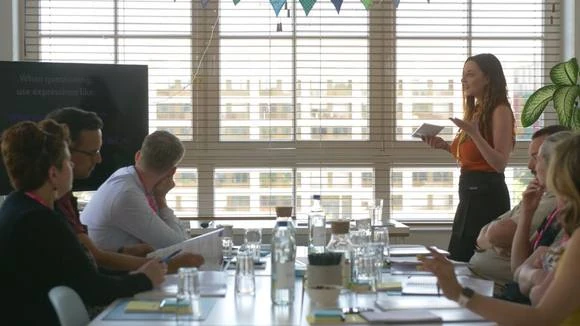
The Facilitation Accelerator is designed the way great facilitation should feel: interactive, practical, energising and built around participation.
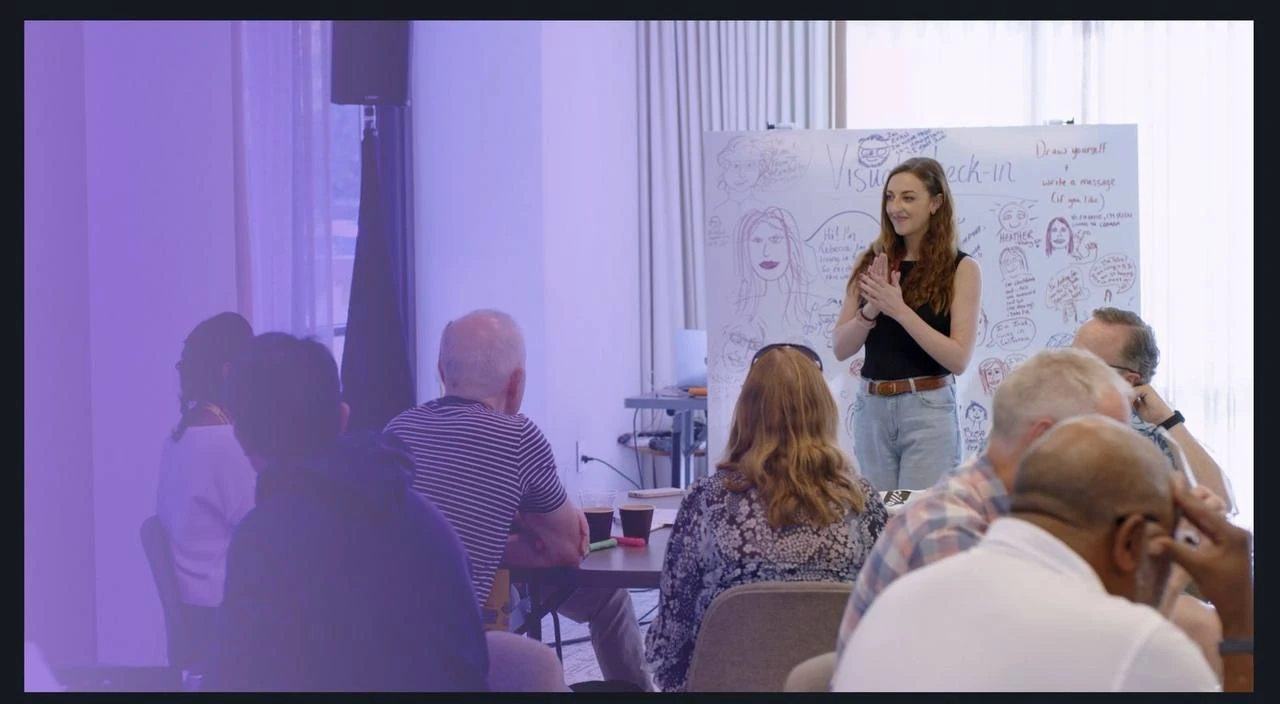
You won't sit through lectures about what good facilitation looks like. You'll practice it, try things, get feedback, and watch Rebecca facilitate in real time, then apply it yourself.


Live teaching sessions every Tuesday. Office hours every Thursday.
Every teaching session is recorded, so you can revisit the material and catch up if you need to.
The frameworks, structures and go-to techniques you'll keep reaching for when you're designing and leading sessions.
Plus client-ready resources and templates you can use in your own facilitation work.
This is your space to practice facilitating, try things out and get real feedback from Rebecca and the cohort.
Bring any question or challenge you're working through - your sessions, your confidence, your clients, or where you want to take your facilitation career.
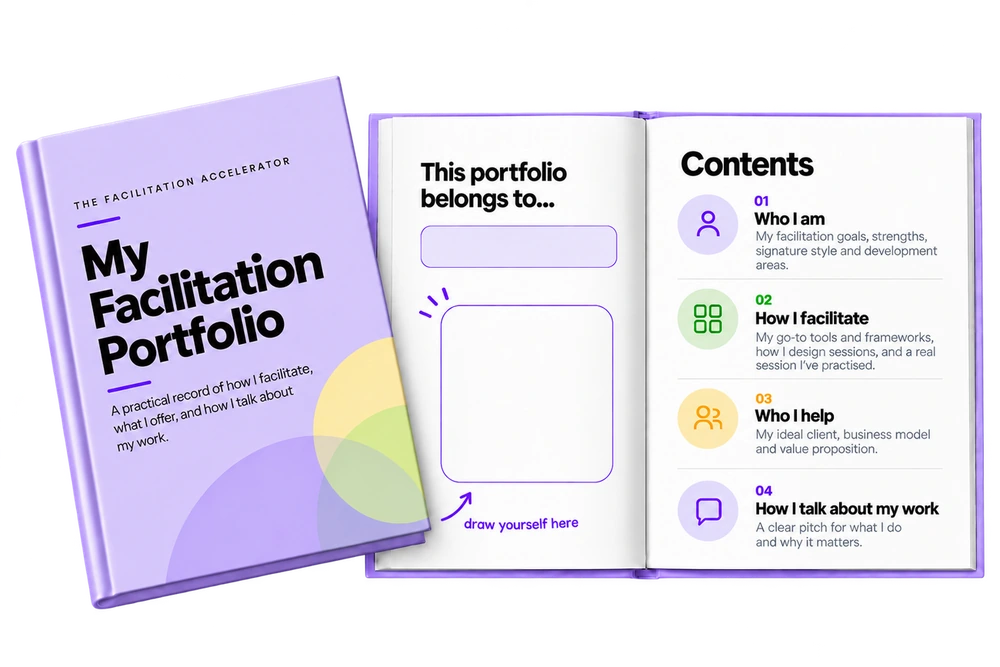
A practical record of who you are as a facilitator, how you work, what you're developing and where you want to take it.
Built week by week. Yours to keep - and keep using - long after the cohort ends.
The cohort is deliberately kept small.
You'll learn alongside a small group of people who are serious about getting better at facilitation - swapping ideas, practicing together and building relationships that can continue long after the six weeks.
Complete the programme and receive your Facilitation Accelerator certificate.
A little something to mark the work you've put in - and something you can add to your LinkedIn or professional profile if you want to.
The Method
Most facilitation training focuses on what to do. But knowing more techniques isn't the same as trusting yourself to facilitate a room.
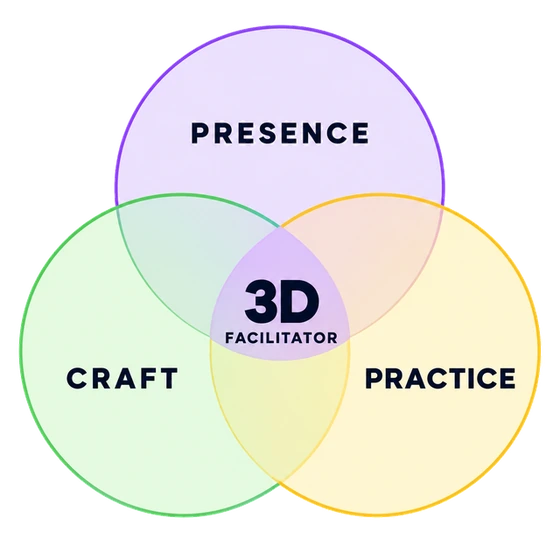
Great facilitators develop three things together:
Craft. Presence. Practice.
They're not separate stages. Each one strengthens the others - and together, they create what Rebecca calls a 3D Facilitator.

The skills and structures behind great facilitation.
You'll learn how to ask better questions, give clear instructions, guide discussion and create meaningful participation - as well as how to turn a brief into an engaging, well-structured experience that people remember long after the session ends.
This is about understanding your natural facilitation style - the strengths you already bring into a room, the habits you fall back on, and how to use all of that more intentionally.
So you can adapt when you need to without feeling like you have to become a completely different person.
The part most training skips.
You'll get reps, a safe place to try things, and real feedback - so you can build confidence before the stakes are high.
Because there's a big difference between figuring something out for the first time in front of a client… and walking into the room having already practiced it.
The Curriculum
Each week builds a different part of your facilitation - from the skills and structures you use, to how you show up, how you adapt in the moment, and how you turn all of that into work people value.
Start with the foundations: why facilitation matters, what great facilitators actually do, and the mindset that sits underneath the work.
You'll strengthen the core skills you use in almost every room - asking better questions, giving clear instructions, listening, guiding discussion, synthesising and helping a group move forward.
Learn a repeatable structure for designing almost any facilitated session - so you're not starting from a blank page every time.
You'll explore the four core activities of a facilitated session and use Design Thinking as a foundational framework for moving a group from understanding a challenge to creating and testing ideas.
You'll also learn how to design for contribution, not consumption - so participants are thinking, talking and doing rather than simply being talked at.
Great facilitation isn't about copying someone else's style.
You'll explore how you naturally show up in a room, the strengths you already bring, the habits that can get in your way, and the areas you want to stretch.
The goal is to understand what makes you you - and learn how to use that intentionally when you facilitate.
The plan will change. Someone will challenge you. Energy will disappear. An activity won't land.
This week is about becoming more flexible without losing your footing.
You'll learn what to notice in a room, how to respond when things shift, when to stay with the plan and when to let it go - and how to get more people contributing when participation drops.
Now you bring the pieces together.
Bring a real session, workshop, client challenge or opportunity you actually want to facilitate. You'll design it using what you've learned, practice parts of it with the cohort, experiment and get feedback before you take it into the real world.
This is where the Accelerator moves from “I understand this” to “I can actually do this.”
Being a great facilitator is one thing. Being able to explain why your work matters is another.
You'll bring together your facilitator identity with the business side: your goals, ideal clients, business model, value proposition and the problems you want to be known for solving.
And you'll practice talking about what you do - so when someone asks, “So, what exactly do you help with?”, you have an answer you actually feel confident saying.
Your portfolio
Across the six weeks, you'll build a practical portfolio that brings together your strengths, style, go-to tools, real work and professional positioning - something you can keep using long after the cohort ends.

The weekly rhythm
Two live sessions a week, on the same days every week. Every session is recorded, so you never fall behind.
The core teaching session each week, live with Rebecca.
Times alternate each week so they work across time zones:
Bring your questions and real challenges and get support.
These times may shift a little depending on the make-up of the cohort.

Your facilitator & trainer
For most of my career, I've been interested in the gap between knowing something… and actually being able to do it.
Before I ever called myself a facilitator, I spent nearly a decade in education. I trained as a teacher, did a Master's in Education, and learned a LOT about how people learn.
And, importantly, that knowing something and being able to do it are two very different things.
Then I moved into facilitation.
Over the years, I've designed and led workshops, training and high-stakes sessions for teams at organisations like LEGO, Spotify, Grammarly and American Express.
I also spent five years at AJ&Smart, one of the world leaders in the facilitation industry, as one of their lead course designers and trainers, helping create some of their most successful facilitation programmes, taken by thousands of people.
I worked across the whole learning experience: designing the curriculum, shaping how people would practice and learn, and then delivering the programmes myself.
All while still doing the work in real rooms with real clients.
So I was in this slightly unusual position of constantly moving between the two:
Facilitating. And teaching other people how to facilitate.
Today I run my own facilitation practice, designing and facilitating workshops for teams and coaching facilitators who want to get seriously good at this work.
And The Facilitation Accelerator brings all of that together.
It's the education part of my brain.
The facilitator part.
The coach part.
And a lot of lessons learned from years of being in rooms where things did not go according to plan. 😂
Because I don't want to teach you more things to know about facilitation. I want to help you become better at doing it.
To practice. Get feedback. Understand how you facilitate. Build the judgement to make decisions in the moment. And gradually need the script a little less because you trust yourself a little more.
It's the programme I wish I'd had much earlier in my own career.
And I'm ridiculously excited to finally be creating it.

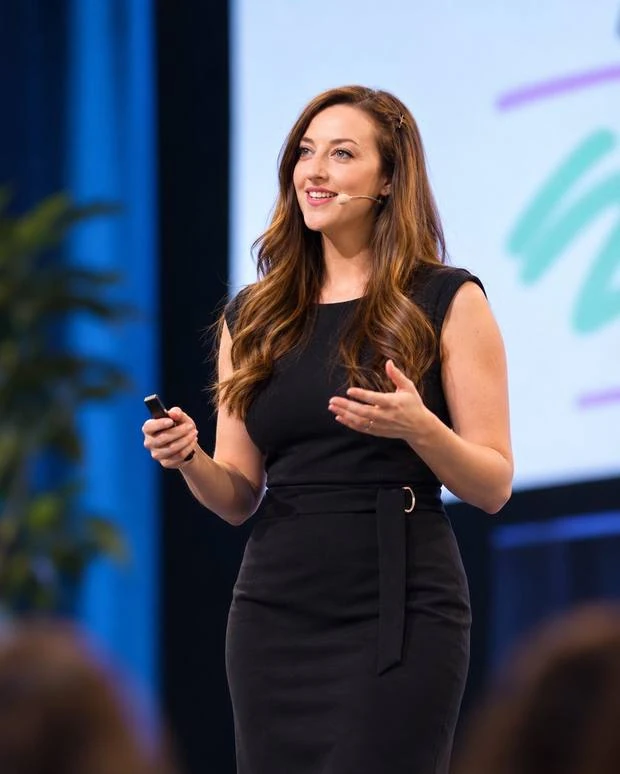
Rebecca has trained and coached thousands of people to facilitate, from individuals building careers in facilitation to teams inside global organisations.
Including teams at
Whether "facilitator" is your job title, or facilitation is a big part of your work as a trainer, coach, teacher, consultant, L&D professional or leader, this is for people who are serious about developing as facilitators professionally.
Facilitators who want to go deeper.
Build real range and confidence in the room, not just another stack of tools.
Trainers and L&D professionals.
Design sessions and trainings people want to be part of, and talk about long after they end.
Coaches and consultants.
Bring strong facilitation to how you work with groups and clients.
Teachers and educators.
Turn your classroom into a space where everyone takes part, not just the confident few.
Leaders and managers.
Run meetings, workshops and offsites people genuinely value.
Anyone building a facilitation career.
Learn to explain your value, so the right people book you.
Testimonials
Amazing to make an online workshop feel so warm and connected, like being in person.
It was so great to feel other people's authentic energy in the Zoom room.
This was a great experience. I learned a lot about online facilitation techniques from a meta level, just by participating.
This meeting is the best group call with strangers that I joined for a long time — I am excited.
This was such a valuable session — and expertly facilitated at that — thank you Rebecca!
A wonderful session! You did a marvelous job consolidating the experience in the virtual room! Thank you, Rebecca!
I am here because I knew if it's Rebecca, it's going to be one of the best sessions.
This has been really fab — highlight of my week so far. Incredibly valuable and super excited to see the outputs. Proof that facilitators are the best!
You're my guru Rebecca. I'm learning a lot and loved listening to all these experiences and wise people. THANK YOU for this possibility!
Limited to 30 people.
This is the founding cohort offer. It won’t be available at this price again.
Join the first week and experience how Rebecca teaches and how the cohort works. If it's not the right fit for you, email her before Week 2 and she'll refund you in full - no questions asked.
Not at all. The Accelerator is built for beginner and early-intermediate facilitators as much as experienced ones. Week 1 starts with the foundations, and being new is actually the perfect time to build the right habits before any shaky ones set in. You'll practice in a small, supportive group, not get thrown in at the deep end.
No. Experienced facilitators come for the full picture - craft, presence and practice in one place - and for a safe room to test new formats and tricky scenarios before running them with a real client. The honest peer feedback and dedicated practice time are worth it on their own, whatever your level.
Yes. Complete the six weeks and you'll earn your Facilitation Accelerator certificate, which you can add to your LinkedIn or professional profile. You'll also leave with your Facilitation Portfolio and a toolkit of frameworks and templates to keep using long after the cohort ends.
Of course. If you're on the fence, email Rebecca, tell her what you facilitate and what you're hoping to get better at, and she'll give you an honest answer on whether the Accelerator is the right fit for you right now. Email Rebecca →
Every teaching session is recorded, so if you have to miss one, you can catch up in your own time. Rebecca encourages you to attend live wherever possible, particularly the live teaching sessions, because participation is a big part of the programme.
The cohort runs from 26 October to 3 December 2026. Live teaching is on Tuesdays, 6–8pm CET (12–2pm EST), with office hours on Thursdays, alternating times each week to suit different time zones. That's twelve live calls over the six weeks, and every one is recorded.
These times are a starting point. Once the founding cohort comes together, Rebecca will check everyone's time zones and lock in the times that work best for the group, so they may shift a little depending on who's in the room.
Live calls run on Zoom, and everything else - your recordings, toolkit, the community and your portfolio - lives in one private space called Facilitator Space, so you've always got a single place to go.
Four hours of live time a week: two 2-hour calls, one on Tuesday (teaching) and one on Thursday (office hours and practice). There's no homework on top of that - the practice happens in the room - and every call is recorded, so you can catch up in your own time if you ever miss one.
The founding cohort is capped at 30. That's deliberate - small enough that you get real attention, real time to practice and real feedback. It's the point, not a limitation.
Hit any "Join the founding cohort" button on this page and grab your place with a one-time payment of €1,750. Founding places open to the waitlist first, and once the 30 spots are taken, enrolment closes.
As soon as you join, you'll get access to Facilitator Space, where everything lives. You can set up your profile, browse around, and see the sessions coming up. The cohort kicks off on 26 October, so between now and then there's nothing you need to do: Rebecca will be in touch with everything you need, and you can add the session dates to your calendar.
€1,750 is the full price, a single one-time payment, with nothing extra to pay. It covers the whole six weeks: all the live sessions, recordings, the toolkit, the community and your certificate.
You're covered by a risk-free first week. Join, experience the first week, and if it's not the right fit, email Rebecca before Week 2 and she'll refund you in full, no questions asked.
Yes, and plenty of people expense it. Rebecca can send an invoice for your company or L&D budget to claim it back - just email hello@rebeccacourtney.com before you enrol and she'll sort it out.
This is your invitation
Join the founding cohort - six weeks, live, capped at 30 people. It takes real work, but it's the kind that will change how you design and lead every room.
Join the founding cohort →Starts 26 October · Live online · 30 places

Information in accordance with § 5 DDG (German Digital Services Act).
Rebecca Courtney
Köpenicker Str. 10A
10997 Berlin
Germany
Email: hello@rebeccacourtney.com
Responsible for the content of this website under § 18 (2) MStV: Rebecca Courtney (address as above).
Last updated: October 2026
I'm Rebecca Courtney, a facilitation trainer and coach based in Berlin. This page is for The Facilitation Accelerator, my paid six-week live cohort. My full contact details are in the Impressum.
This page has no sign-up form of its own, so what's collected depends on what you do:
Just visiting: my host, Netlify, automatically logs standard technical data (such as your IP address and browser) to keep the site secure and running.
Joining the waitlist or email list: I collect your email address to send you updates about the Accelerator and occasional helpful resources (you can unsubscribe anytime). This is managed through Kit (formerly ConvertKit).
Enrolling: your payment is processed by Stripe, and your course access and community profile are hosted on Mighty Networks. These providers handle the data needed to take your payment and give you access to the cohort.
Kit: kit.com/privacy
Stripe: stripe.com/privacy
Mighty Networks: mightynetworks.com/eu-privacy-notice
Netlify: netlify.com/privacy
You can ask to access, correct or delete your data, object to or restrict its processing, and withdraw consent at any time. You also have the right to complain to a data protection authority — for Berlin, the Berliner Beauftragte für Datenschutz und Informationsfreiheit. To make a request, email hello@rebeccacourtney.com.
This page sets no cookies of its own. Stripe and Mighty Networks may set their own cookies when you continue to their checkout or platform.
Rebecca Courtney — hello@rebeccacourtney.com